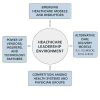
Leadership
Though the concept of leadership is a somewhat nebulous term,
4 an agreed-upon textbook definition of leadership is “the ability to influence a group toward the achievement of a vision or a set of goals.”
5(p One of the most important lessons to be learned from the field of organizational behavior is that leadership is a skill that can be taught.
6,
7 Importantly, there are different formal leadership styles, and leaders can and should select elements from each that align with their own personality traits and strengths, rather than feeling they must change their core identity as they advance in their leadership journey. Some examples of the most common leadership styles are authentic, authoritative (versus authoritarian), transformational, and servant (
Table 1).
8–
11
A combination of transformational leadership9,12— where the focus is on inspiration rather than command—and servant leadership is frequently cited as an effective approach. In servant leadership, a term coined by Robert K. Greenleaf in a 1970 essay,13 the primary role of the leader is to support their followers (Table 2). Servant leadership inverts the norm: instead of the people working to serve the leader, the leader exists to serve the people. A servant leader is a leader among equals, a crucial point for healthcare leaders, as they frequently have the challenge of leading their former peers. According to Greenleaf, a Servant Leader should be focused on asking if those served grow as persons. Do they, while being served, become healthier, wiser, freer, more autonomous, and more likely themselves to become servants?10,13–16 An example of this type of leadership was the theme of Marquet’s work, Turn the Ship Around, describing an empowering and supportive approach to managing subordinates.17 For a critical care clinician who either has or plans to assume more leadership roles, taking some time to delve deeper into the literature of leadership styles is time well spent: the more of a structured approach one has to a situation, the less likely one is to come up with reflexive responses that one may regret in the future.
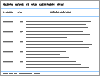 | Table 2Characteristics of an Effective Servant-minded Organization. 13, 15, 16 |
Management
Though the concepts of leadership and management are both important, they are not synonymous (
Table 3). As noted above, the goal and role of leadership/leaders is to use strategy to develop short-term and long-term plans as well as create an organizational culture and inspire members of the organization toward a unified goal. In contradistinction, the primary focus of management is to work with front-line staff to operationalize the ideas and vision of the leadership team.
12,
18–
22 Leadership takes a
what-should-we-do approach, whereas management takes a
how-do-we-do-it approach. An example of leadership in healthcare would be to recognize that Intensive Care Unit patients need world-class care with a target of zero central line infections and urinary tract infections. The management perspective on the same issue would be the creation of a dedicated committee devoted to achieving this goal by tracking the rates of these infections and designating certain staff members to interface with the clinical teams to heighten awareness of these hospital-acquired conditions, thereby creating a structured approach to prevention. It is common for clinician leaders (especially in smaller or resource-constrained organizations) to simultaneously perform leadership and management functions or to frequently alternate between the two states.
| Table 3Characteristics of Leadership, Management, and Both. 19, 20, 22 |
In addition to simply understanding the definition and meaning of the concepts of leadership and management, it is often the case that for one to become a successful leader in healthcare, one must master certain management skills that are not part of routine training. A commonly used example is that of how to run an effective meeting23 (e.g. creating and archiving agendas and minutes as well as understanding and implementing the organizational behavior of groups—allowing everyone to provide input while preventing disruptions from attendees who may be more comfortable speaking in groups). Though at first glance these ideas may sound simple—and potentially even trivial—the determination of the optimal frequency and size of meetings can be complex and have significant consequences for the efficiency and functionality of an organization.24
Other Important Aspects of Organizational Behavior
Over and above leadership and management, there are numerous other important relevant concepts that fall under the rubric of organizational behavior.
25 As discipline, organizational behavior is a multidisciplinary study—with contributions from the fields of psychology, social psychology, sociology, and anthropology—focused on employee interactions and organizational processes that promote more efficient and cohesive organizations. Examples include: motivation, personality types, organizational culture, group behavior, decision-making, understanding teams (groups versus teams),
26 communication, power/politics/influence, conflict management,
27–
30 the art of negotiation,
31–
33 organizational design, and emotional intelligence.
34
Accounting, Finance, and Budgets
Potentially daunting areas of leadership and management that clinicians may encounter as they progress further into their leadership journey can be the topics of accounting, finance, and budgets, with a significant number of us having little or no formal training in this area.
35–
37 Firstly, it must be noted that the field of accounting is broadly divided into financial and managerial accounting.
38,
39 Financial accounting involves recording, summarizing, and reporting transactions and economic activity. In contrast, managerial accounting identifies, measures, analyzes, interprets, and communicates financial information to internally support organizational goals.
39 Financial accounting is a highly regulated industry where corporations are mandated to present their financial transactions externally (e.g. to shareholders, lenders, banks, and government agencies). It is beyond the scope of this paper to provide significant detail for either financial or managerial accounting other than to say that the customary financial statements (e.g. balance sheets, income statements, statements of shareholder equity, and statement of cash flow) are largely standardized and agreed-upon in terms of their content and format. Such rules do not apply to managerial accounting as the data are used for internal organizational purposes. Remember that a budget is simply a predicted income statement/profit and loss statement. Partnering with a local organizational administrative/finance asset can help to facilitate the generation of relevant budgets. Though it is not mandatory that a formal degree be obtained to develop familiarity and a comfort level regarding the financial statements, some form of education may be of significant value as the clinician leader develops in their journey.